Category: Media news

YouTube to co-sponsor next offical debate for Democratic presidential candidates

How about this nugget? According to a story in today’s San Jose Mercury News, YouTube will co-sponsor the first of six Democratic Party-sanctioned debates.

Presumably, this will be somehow tied into YouTube’s YouChoose campaign, in which presidential candidates post videos and speak directly to viewers. (Well, maybe an intern or something.)

Word is, says Pete Cashmore in a blog on Mashable.com, that YouTube will also look to sponsor a Republican-sanctioned debate, to keep balance.

If anything, it’ll be interesting to see the community boards on YouTube light up after this debate.

Free access to Wall Street Journal, Financial Times articles (Congoo.com)

I just got a tip from one of my readers about a way to get free access to stories from the Wall Street Journal, Financial Times, Morningstar, etc.

Congoo.com, the person suggested, is a great way to do it. A bit skeptical – and thinking the post may be spam – I checked it out. Congoo NetPass is a pretty strong program, combining limited access to specialized news with some social networking.

The fact that it’s a downloadable toolbar may scare off some folks, but it seems legit. Congoo may be more appropriate for people who may not normally read the Journal and Financial Times, but hey, it doesn’t hurt that it’s free.

Media news: Virgin Media shareholders to talk strategy with Richard Branson

After a subpar 1Q, Virgin Media is now talking strategy.

Well, more like trying to convince its shareholders that there’s any strategy behind the company. Losses during the first quarter were about 74 cents/share. And now Franklin Mutual Advisers is calling a meeting with Virgin Media brass to find out what’s up. Franklin holds the second-largest stake in the company, owning 9.4 percent of its shares. Sir Richard Branson, Virgin Media’s biggest shareholder, has 11 percent.

As I put the final touches on a presentation on Branson for next week, I’ll be following this story.

Artvoice site redesign looking good; print product next?

Artvoice logo

In a bout of nostalgia (must be a sign of the apocalypse) I just checked out the new Artvoice site. Artvoice (and its talented editor-in-chief Geoff Kelly) gave me a shot at a few features.

He decided to turn two of them into my very first cover stories. (Check them out here and here. Geoff generously gave me a co-byline on the first piece.)

The big change I noticed on the site was the inclusion of Web 2.0 features like Digg and Del.icio.us. This was hugely necessary, as neither of its two biggest competitors – the Buffalo News and Buffalo Rising – carry any real 2.0 functions, except for, say, RSS feeds and comment fields.

And the banner font is much sleeker, I must say.

One function that got lost in the redesign was the ability to view the print version in PDF form, something I was able to do on the old site. (A working journalist, I need to print out my clips!)

My question to Artvoice is: Are there any plans for a print redesign in the works?

Update #2 from Kellog Social Media Symposium: More innovation from Organic, Inc.

Chad Stoller

Mark Kingdon, CEO of Organic, Inc., presents the future of social networking

I think it’s interesting that the folks from Organic, Inc. were chosen to give the keynote speech at Kellogg’s Social Media Symposium. While all participants probably had interesting things to say, they really seem to have an idea of how to market through social networking.

Chad Stoller introduced the idea of tracking users through the areas. “Social networking is a mainstream function of the Web,” he said. Stoller showed us slides of a typical user and their Web usage in the past, present and future.

Here are some future trends, said Mark Kingdon, CEO of Organic:

1) Social media will go niche (and vertical and mobile)
2) Advertising will be by invitation only
3) Marketing will have to “give to get”.
4) Over the long-term, money will move from advertising to product development.
5) Community becomes content.

“The real goal,” he said, “is to be more like Craig Newmark and less like Rupert Murdoch. You have to be committed to giving to a community.”

Let’s see if this happens…
(Taken from presentation slides)

Update from Kellogg Social Media Symposium

Chad Stoller

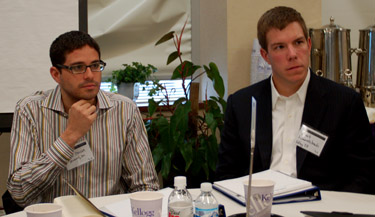
Chad Stoller (left) of Organic, Inc., discusses the aftermath of purchasing social media with fellow execs and Kellogg students (Photos copyright Daniel B. Honigman)

Kellogg’s Social Media Marketing Symposium got off to a good start Tuesday, as news-types and Web behemoths alike rubbed shoulders and drank coffee in the somewhat cramped quarters of Kellogg’s 4th floor conference room.

I started chatting with Scott Skurnick of Edmunds.com, the #1 (ranked by Google) car search service about their branding experience with social media. For all of you aspiring online entrepreneurs, even the big boys are using Google as their big gun, which is equally good and bad.

“You never want to depend solely on one source, but that’s the way [the search engine business] has become,” he said. “If you lose your rankings on Google, you’re out of business.”

Edmunds is comparable to the Kelley Blue Book brand, the brand. Thing is, said Sturnick, they’re just not doing anything online.

“Brands and properties have to realize that negativity is out there, and they need to police it,” said Chad Stoller, Executive Director of Emerging Platforms for Organic. For newspapers, they’ve forgotten that they’ve always been leaders and conversation starters. Newspapers that don’t want to blog — I just don’t get that.”

“If you’re the newcomer or the advertiser to the social media party, you have to bring some beer and pizza,” he continued. “If you don’t contribute something… and give back to the community, you’re not enhancing the experience.”

The beer and pizza, he said, were upgrades to social media platforms. A MySpace plug-in that lets people see their top 24, instead of eight friends.

We can create the social media, but can we attract the 18-24 year olds?”, asked Tony Wright of Schurz Communications. My guess: No, it can’t be done. Unless there’s unique content.

More to come, folks.

Today: Kellogg conference on social media marketing

Kellogg Logo

Hey, all. I’ll be blogging later on about this conference the Kellogg Business School is hosting. It should be interesting, because it’s about marketing.

Here are some questions for the speakers:

1) Why have all attempts at social media done by big companies failed? (Except for, say, AOL when it started)

2) How can companies be innovative when they essentially turn into bureaucracies? (Think Microsoft, Yahoo, and maybe Google in the future)

3) How can brand engagement even be accurately measured online? Hits? Visits? User testing combined with these statistics? I think that even if McDonald’s had a cool Web site, I won’t be more inclined to go buy a Big Mac.

These are just some questions I may have, but by the end of the day, I certainly will have blogged about the conference.